Monday, March 16, 2020

causes of war and early events please copy all notes


After you watch videos please create a 5-7 bullet summary of each video All summaries are due by Saturday 3/21
Please title each Summary based on the video title. this will take you up to the end of the war


Please read the following and answer the questions that follow

The Manhattan Project and the atomic bomb

In 1945, the United States dropped two atomic bombs on Japan, ending World War II. 

Overview

  • The United States detonated two atomic bombs over the Japanese cities of Hiroshima and Nagasaki in August 1945, killing 210,000 people—children, women, and men.
  • President Truman authorized the use of the atom bombs in an effort to bring about Japan’s surrender in the Second World War. In the days following the bombings Japan surrendered.
  • The Manhattan Project was the US government program during World War II that developed and built these first atomic bombs.
  • The detonation of these first nuclear bombs signaled the arrival of a frightening new Atomic Age.

The Manhattan Project

The Manhattan Project was the codename for the secret US government research and engineering project during the Second World War that developed the world’s first nuclear weapons. President Franklin Roosevelt created a committee to look into the possibility of developing a nuclear weapon after he received a letter from Nobel Prize laureate Albert Einstein in October 1939. In his letter, Einstein warned the president that Nazi Germany was likely already at work on developing a nuclear weapon. By August 1942, the Manhattan Project was underway.start superscript, 1, end superscript
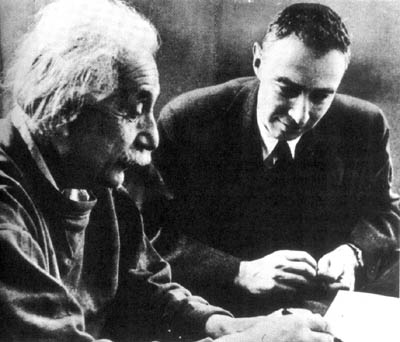
Photograph of Albert Einstein and J. Robert Oppenheimer.

Albert Einstein and J. Robert Oppenheimer. Einstein warned that the Germans were researching an atomic bomb and suggested that the United States do the same. Oppenheimer was the leading scientist at Los Alamos National Laboratory. Image courtesy Wikimedia Commons.
By 1944, six thousand scientists and engineers from leading universities and industrial research labs were at work on the development of the world’s first-ever nuclear weapon. Robert Oppenheimer, a physicist, headed the Los Alamos National Laboratory, the Manhattan Project’s principal research and development facility. For security reasons, the facility was located in the desert near Los Alamos, New Mexico.
Major General Leslie Groves oversaw the Manhattan Project for the US government. Private corporations, foremost among them DuPont, helped prepare weapons-grade uranium and other components needed to make the bombs. Nuclear materials were processed in reactors located in Oak Ridge, Tennessee and Hanford, Washington. At its peak, the Manhattan Project employed 130,000 Americans at thirty-seven facilities across the country.
On July 16, 1945 the first nuclear bomb was detonated in the early morning darkness at a military test-facility at Alamogordo, New Mexico. The intense brightness of the explosion’s flash was followed by the rise of a large mushroom cloud from the desert floor. House windows more than fifty miles away shattered.

Hiroshima and Nagasaki

In May 1945, the Allies defeated Germany, two months before the atomic bomb was complete. War with Japan continued, however, and In August 1945 it seemed that an invasion of Japan itself might be necessary to force the Japanese to surrender. Military advisers to President Harry S. Truman warned that such a ground war would result in the deaths of tens or hundreds of thousands of young men in the US Armed Forces, as well as the deaths of many Japanese military personnel and civilians. After receiving no reply to his threat that "prompt and utter destruction" would follow if the Japanese did not surrender unconditionally, Truman authorized the use of the bomb on Japan.squared
On August 6, 1945 an American B-29 bomber named the “Enola Gay” dropped the first atomic bomb on the city of Hiroshima. The device exploded over the city with a force of 12,500 tons of TNT. “[The city] had been there just a few minutes before . . . but it was absolutely gone,” said one witness. About 140,000 people were killed instantly or died due to injury or radiation poisoning within months of the blast at Hiroshima.cubed
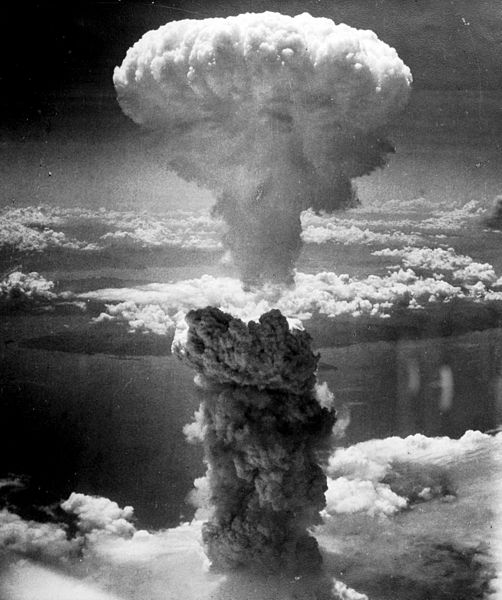
Photograph of the mushroom cloud following the atomic bombing of Nagasaki, Japan.

Mushroom cloud following the atomic bombing of Nagasaki, Japan. Image courtesy National Archives.
Truman called for surrender the day after the bombing at Hiroshima once more, but once more the Japanese government refused. On August 9, about 80,000 people died after the United States dropped a second bomb on the Japanese city of Nagasaki. A total of 210,000 civilians died in the two atomic blasts. (In comparison, the United States had killed 120,000 Japanese civilians with conventional bombs during air raids on Tokyo in March 1945.)start superscript, 4, end superscript
Six days later, after the Soviet Union declared war on Japan, the Japanese government signed an unconditional surrender. World War II was over.
The development of the atomic bomb had repercussions that would continue to resonate throughout the twentieth century, particularly in the Cold War. Spies within the research and development facility at Los Alamos—most notably the scientist Klaus Fuchs—gave the Soviet Union information about the nuclear program that helped the Soviets develop their own atomic weapon by 1949.start superscript, 5, end superscript

Was the bombing of Hiroshima and Nagasaki necessary?

Truman’s decision was framed by his belief that the bombing of Hiroshima and Nagasaki would shorten the war and thereby save the lives of tens or hundreds of thousands of American soldiers as well as untold numbers of Japanese soldiers and citizens.
However, in the years following the war—and to this day—the United States’ use of nuclear bombs against the civilian populations of Hiroshima and Nagasaki has had both proponents and detractors. Many questions remain about the necessity of using the bomb and its moral implications: Would the United States have acted so quickly to use nuclear weapons against Europeans? Was racism against the Japanese an element in the decision? Might the United States have exploded a nuclear bomb on an uninhabited island to demonstrate the bomb’s terrible power instead of destroying two cities? Might the United States have been able to gain Japan’s unconditional surrender by other means?
But there was no question that the development and use of the atomic bomb changed the nature of world warfare forever. Though the bombings of Japan remain the only wartime use of nuclear weapons, since 1945 the threat of nuclear war has loomed over international conflicts, promising a level of "prompt and utter destruction" never before seen in the world.

Questions (3 quiz Grades due Sunday 3/22)

1. What might have happened if Nazi Germany had developed a nuclear weapon before the United States?

2. In what ways did scientists, engineers, corporate leaders, American workers, and the military come together in shaping the successes of the Manhattan Project?
3.Was the decision to drop the atom bombs on civilians morally justifiable?


Thursday, February 6, 2020

enduring issue essay outline and example paper

Enduring issue essay outline

Paragraph 1 introduction:
An enduring issue is a challenge or problem that has been debated or discussed across time. Throughout history many societies have attempted to address these issues with varying degrees of success. Enduring issues continue to impact society in numerous ways. One example of an enduring issue is _____________. This issue can be defined as… ________________________ _______________________. Some examples of this enduring issue include ___________, ___________, and _________________.
It is one that many societies have attempted to address with varying degrees of success and failure.

Body Paragraphs • Each selected document becomes the focus of a body paragraph • 3 Documents = 3 body paragraphs

A.   How is the Enduring Issue affecting people across time? How
1.     Cite evidence to support your answer to the question. Use the document as evidence and outside information

Topic Sentence: __(selected issue)___ was an enduring issue during __(time period). 2) This was an enduring issue because __(reason)___ o Use evidence from the document to explain why this was an enduring issue and how it affected people (or how people affected the issue) o Use outside knowledge to explain why this was an enduring issue and how it affected people (or how people affected the issue) o Use relevant facts, examples, details that demonstrate the enduring issue and how it affected people (or how people affected the issue).


Argue that this has continued to be an issue in this region because _____________ OR Argue that the issue in this region has changed over time because __________ o Use relevant facts, examples, and details to support your argument


Conclusion
___________________is an enduring issue that exists across time. One Body Sum-Up (The Key Idea) for each body paragraph. KEEP it short and sweet! Copy the statement below for your closing sentence.

Even though societies develop and change, they are unable to escape common issues and problems associated with human nature.


 Sample paper 
Introduction
Throughout history, governments, ideas, and ways of life always change. An enduring issue that has existed over time is the tendency of societies to oppose that change. Some people greatly opposed change and wanted life to stay as it was. Opposition can take many forms. Opposition to change is a significant issue that has occurred throughout history and has led to cultural and political changes in many countries as demonstrated by Luddites and others who opposed the effects of industrialization in England, reactions against the Iranian government in the 1960s, and those who opposed changes to education in Meiji Japan.  
Body Paragraph 1: Example 1, Industrial Revolution
Some people opposed changes that resulted from the Industrial Revolution in England. During the early 19th century, England experienced the Industrial Revolution which completely changed the way people worked and lived. The factory system moved the creation of goods from homes to factories and people moved to where those factories were, in cities. Industrialization had some negative effects. For example, laborers in factories faced long hours, poor ventilation, a lack of safety measures, and low wages. Children were often employed and mistreated as well. In addition, the spread of industry led to poor conditions in the cities where laborers tended to live. These conditions included overcrowding, poor sanitation, pollution, disease, and poverty. The Luddites were a group of experienced artisans that opposed machine power in the factories. The new machines produced more goods, quicker than humans could, so these machines threatened the workers’ jobs. This change greatly benefited the factory owner at the expense of their employees. In response to these problems, the Luddites broke into factories at night so they could destroy the machines that replaced them (Doc 1). Other people tried to address the working conditions in factories and poor living conditions in cities by getting the government to pass laws to prevent them.
Body Paragraph 2: Example 2, Iranian Revolution
Another group that opposed change were some Iranians in the late 1960’s after an economic downturn. They blamed this downturn on the opening of economic relations with the West, specifically the U.S. They opposed the Iranian Shah’s decision to maintain “close relations with the United States, Iran’s sale of oil to Israel, the corruption of the regime, and Iran’s failure to help it’s masses of poor people (Doc 3).” These Iranians believed their culture was changing drastically which threatened their traditional clothing, shelter, food, literature, and press. (doc 3), so they reacted against it. Tensions grew as these problems prevailed. This eventually led to the Iranian Civil War, between those Iranians who supported and those who opposed the U.S. backed Shah and his policies. The Shah would eventually be overthrown by Khomeini and his supporters and relations with the U.S. worsened. Khomeini turned Iran into a theocracy, a religiously-based government, that based its laws on Islamic ideas. In Iran in the 1960s and 1970s, opposition to change led to a political revolution that changed the country and led to tensions between it and others in the region and the rest of the world. 
Body Paragraph 3: Example 3, Meiji Restoration
Another region in which societies opposed change was in Japan in terms of its educational policy during the Meiji period. With the U.S. pressuring the opening of Japan, the nation moved away from Tokugawa isolationism and Japanese leaders struggled with the question of how much western influence to accept. Meiji rulers saw benefits from quickly adopting western industrialization, but were also concerned over losing Japanese culture. In the 1870’s and 1880’s western educational practices were used in Japan, but some Japanese began to oppose this, by calling for more traditional content. Both “Shinto” and “Confucian” ideals and morals were being blended with the new western curriculum in schools. Students also followed the “Imperial Rescript on Education,” which stated that one must give everything they have in order to protect their nation. This policy reflected a traditional way of thinking, similar to the samurai code of honor, Bushido. This made one loyal and honorable. The Meiji Restoration caused Japan to examine how much change they would accept or oppose and in many cases resulted in a blend. As a result, of opposition to change in education during the Meiji Restoration, Japanese children learned, who later became Japanese leaders had an education that included Japanese culture and western topics.
Conclusion
Throughout history, new ideas introduced into a society have been met with intense opposition. Though the historical and geographic circumstances have been different, people throughout history and today continue to react to change. During the Industrial Revolution, people like the Luddites reacted against changes to technology that threatened their jobs. Similarly, today modern technology in the form of computers, software and robots continues to replace skilled and unskilled workers in a variety of fields. Even cashiers are being replaced by machines with touch screens that customers can use to check themselves out. While the reactions to change during the Industrial Revolution were in response to new technology, in Iran in the 1960s and 1970s and in Japan during the Meiji Restoration people reacted against the influence of other countries on their own. In Iran, people led by Ayatollah Khomeini were unhappy with how much influence the United States had over their country’s leader, which led to a revolution in 1979. Similarly, some Japanese reacted against the influence of the United States in their education system, however instead of a revolution, they made changes from within the government by adding culturally Japanese topics to the curriculum. Though they took place in different locations and at different times, the effects of opposition to change have had deep and lasting impacts on the social, economic, and political aspects of the societies where that opposition took place and the same continues today.